Permission analysis as a service for more transparency and security
Many organizations have built up functioning file server structures over the years, which have become increasingly complex over time. Folders have been renamed, teams have been restructured, employees have come and gone. What often falls by the wayside is the overview of who can actually access which data.
With BAYOOSOFT permission analysis, you can create transparency before it becomes a security or compliance problem.

Companies that already rely on BAYOOSOFT:


Established structures, invisible risks
File server authorizations are rarely created according to plan. In practice, it often looks like this: Access rights are assigned in day-to-day business, inheritances reach deeper than intended, groups are nested within each other until no one can tell right away what effective permissions certain users actually have. User accounts entered directly in NTFS Access Control Lists (ACLs) instead of groups, broken inheritance chains and access creep due to role changes do the rest.
The result is not malicious intent, but a typical result of organically grown IT structures. Nevertheless, this creates real risks: sensitive data that can be accessed by more people than necessary, authorizations that have never been revoked after a job change, and structures that are difficult to explain in the event of an audit.
Typical warning signals are confusing NTFS ACL structures with deeply nested group relationships, direct user entries in ACLs instead of cleanly managed AD groups, interrupted authorization inheritance, excessively broad access rights to sensitive directories and orphaned SIDs of former employees who have remained in the system.
Questions that we encounter in such situations are, for example:
Analyze file server permissions: This is included in the service package
The BAYOOSOFT permission analysis is a structured service package that provides you with a well-founded, independent evaluation of your current file server authorization situation. No estimates, no gut feelings: you receive a tool-supported analysis based on your actual environment.
What is analyzed
Our experts check your environment systematically, tool-supported and based on your actual data. No random samples, but a complete evaluation.

Permission analysis and compliance: ISO 27001, NIS2, GDPR
Organizations that have to meet the requirements of ISO 27001, BSI IT-Grundschutz, NIS2 or the GDPR face a common challenge: they must be able to track who is allowed to access which data at all times, whether access rights have been assigned appropriately and whether the principle of least privilege is being observed.
A structured permission analysis of the file server environment is a concrete and documentable step in this direction. It forms the basis for identifying existing weak points and implementing compliance requirements in a targeted and comprehensible manner.
Who is the permission analysis suitable for?
The permission analysis is aimed at organizations with larger file server environments or complex, historically grown permission structures. It is ideal for teams that have already carried out initial analyses and now want a well-founded, tool-supported evaluation of their situation.
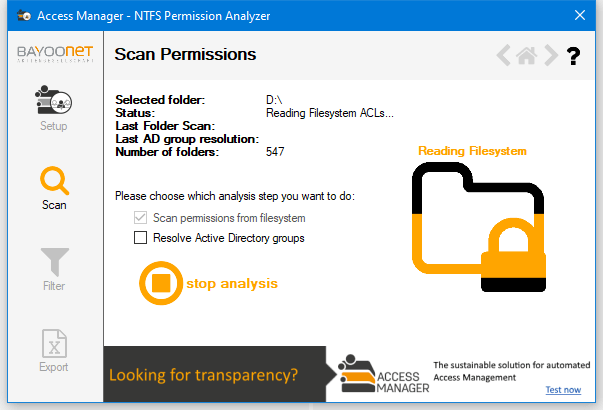
Tip: Get started for free with the
NTFS Permission Analyzer
The free NTFS Permission Analyzer from BAYOOSOFT provides an initial introduction to the analysis of your permission situation. With just a few clicks, you can scan specific areas of your file server and receive an overview of the current NTFS permissions, exportable as Excel.
What happens after the analysis?
The permission analysis is deliberately designed as a stand-alone entry point. It creates transparency and shows where there is a need for action. You decide what follows from this.
The BAYOOSOFT Access Manager is the right solution for anyone who wants to set up clean, automated and audit-proof authorization management in the long term: it standardizes authorization processes, continuously monitors structures in real time and automatically corrects deviations. The results of the analysis can be used as the basis for a targeted clean-up and the introduction of structured authorization management.

Arrange permission analysis
Are you concerned with the topic of file server permissions and would like to know what the real situation is in your environment?
Together we will find out whether and how the permission analysis makes sense for your situation, what the next steps are and how we can support you