Auto-authorization correction: How authorizations remain permanently correct
An employee changes department. The new role is neatly applied for, approved and implemented. What often remains: old project access, former special rights, “temporary” authorizations that nobody thinks about anymore. Everything fits on paper, but no longer in the system.
Such situations are not caused by poor authorization concepts, but by a lack of enforcement during ongoing operations. Roles change, projects end, responsibilities shift. However, authorizations often do not follow these changes automatically. This is precisely where the auto-authorization correction comes in.
In this article, we show why it is more than just a technical function and what role it plays in permanently effective authorization management.
Three basic philosophies in authorization management
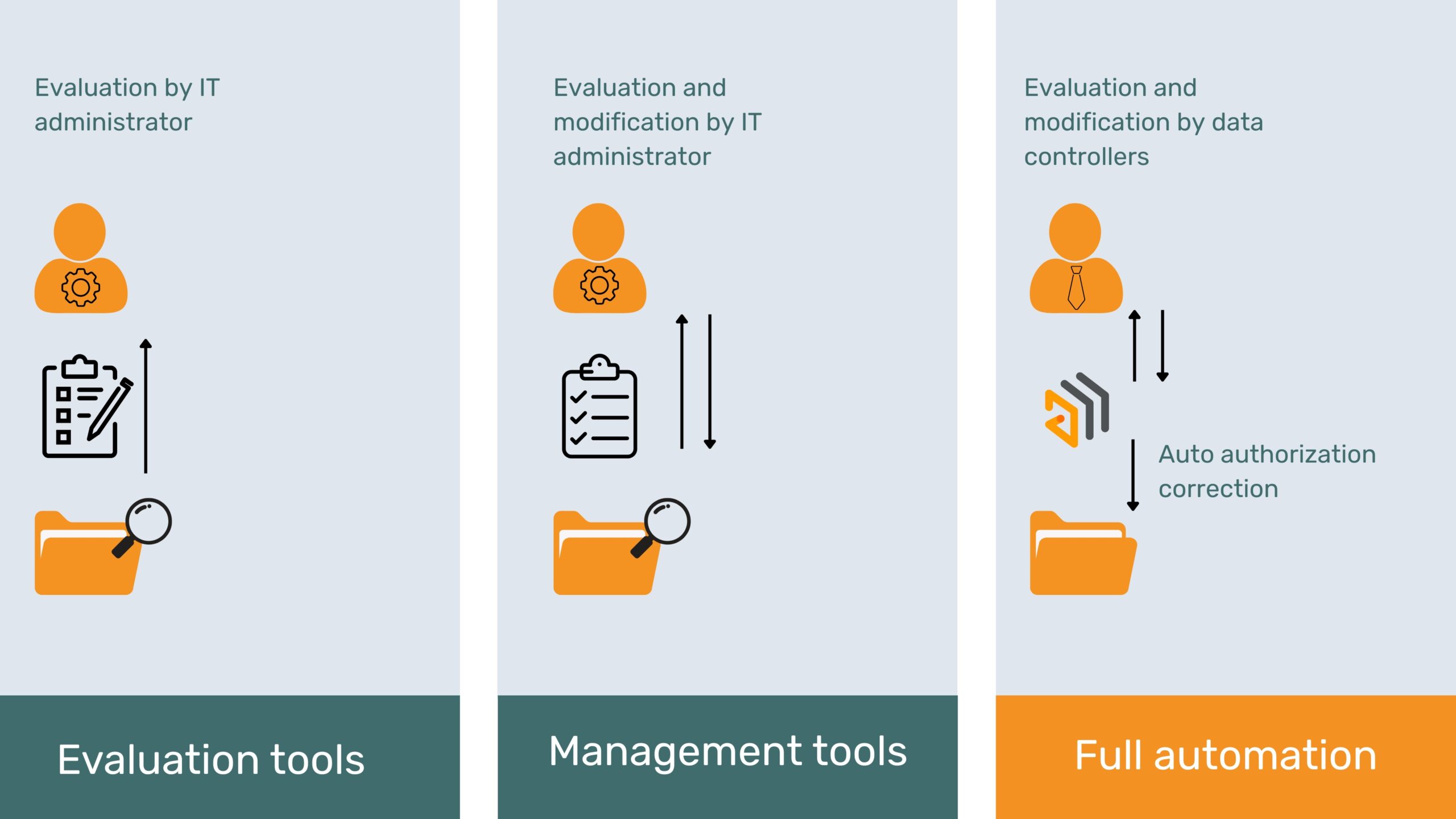
In practice, authorization management solutions can be roughly divided into three categories, each of which takes a different approach.
- Evaluation tools analyze the current status and identify over-authorizations, deviations and potential risks. They create transparency and make it clear where there is a need for action. However, the actual correction remains manual and IT teams have to fix the identified problems by hand.
- Admin tools go one step further and make IT’s operational work considerably easier. Changes can be implemented more quickly, in a more structured and comprehensible manner. Nevertheless, responsibility and effort remain centrally concentrated in the IT department.
- Automation and governance solutions take a fundamentally different approach: they ensure that approved authorizations are not only documented, but also technically enforced on a permanent basis. Deviations are not only made visible, but also consistently and automatically rectified.
What does auto-authorization correction mean in concrete terms?
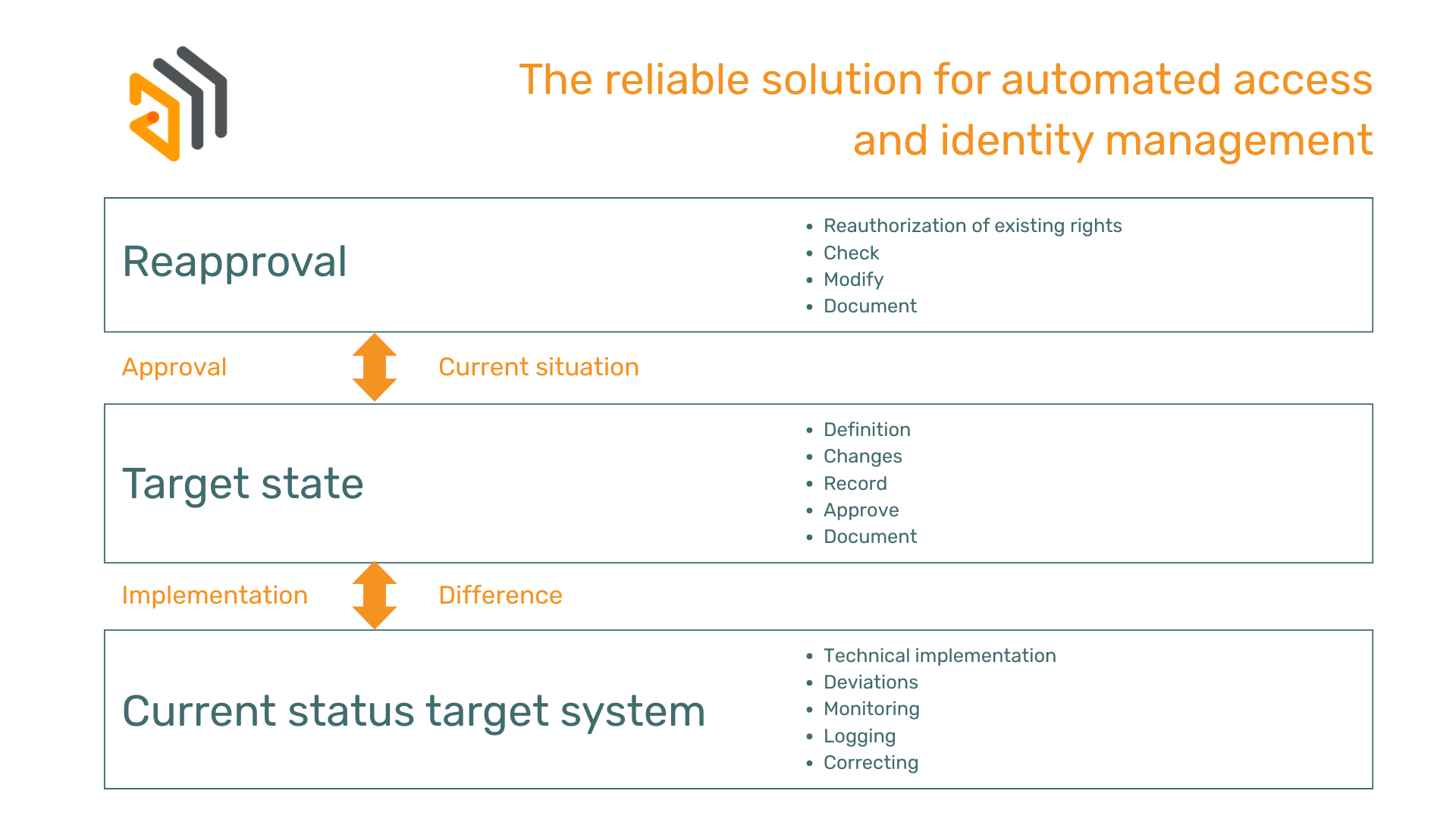
Auto-authorization correction ensures that the approved target status is maintained during operation. Instead of just documenting or reporting, the system actively intervenes and restores the correct authorization status.
This is done in three consecutive steps:
1. continuous target/actual comparison as a foundation
Defined roles, policies and granted authorizations are regularly compared with the authorizations actually assigned in the target systems. Deviations are automatically detected, such as additional individual rights that were never requested or outdated access from completed projects. This comparison runs continuously in the background and does not require any manual intervention.
2. rule-based evaluation for intelligent decisions
Not every deviation is equally critical or problematic. Auto-authorization correction identifies all deviations from the defined target status, logs them in a traceable manner and corrects them in the target system on the basis of defined rules and responsibilities. This clearly distinguishes which deviations are automatically corrected and which require a technical review.
Typical deviations are, for example, additional groups or persons who have been authorized on a target resource such as a directory, additional accounts in existing AD groups or authorized accounts that are no longer members of a group and have therefore lost their authorizations. Changes such as removed list permissions, undocumented activated permission inheritance or moved files with subsequently incorrect permissions are also detected and cleaned up.
This ensures that authorizations are not blindly withdrawn and that departments are not burdened with unnecessary queries. The approved authorization status thus remains consistent and consistent.
3. automated correction and structured workflows
Invalid or obsolete rights are automatically withdrawn or restored to the approved role status. In borderline cases that require a technical assessment, the responsible persons are specifically involved. Their decisions are then implemented technically and documented in an audit-proof manner. This creates a closed control loop that turns a pure control mechanism into an active governance solution.
Why auto-authorization correction makes the difference
Without automated correction mechanisms, typical problems arise that gradually build up and eventually become a real burden. Employees retain authorizations from previous roles or completed projects. Project or special rights do not expire automatically, even if this was originally intended. Authorization concepts and the actual status in the systems are increasingly drifting apart. Audits thus become a manual feat of strength in which attempts are made under time pressure to create a status that should actually have been permanent.
Classic admin tools make such deviations visible, for example through evaluations or graphical representations of authorization structures and circular references. However, they do not actively intervene.
Auto-authorization correction goes a decisive step further: automated assignment and revocation mechanisms based on defined rules, time periods and approvals prevent problematic constellations from arising in the first place. This permanently relieves the burden on IT, integrates specialist departments into the responsibility in a structured manner and ensures that compliance is not only adhered to selectively during audits, but continuously during ongoing operations.
Transparency alone is not enough
Many organizations focus on making permissions transparent through reports, dashboards or recertification processes. This is an important step to ensure that it is not only questioned at a technical level, but also at a professional level, whether rights are still required.
However, this alone does not provide security. As long as identified problems are not systematically rectified, the gap between knowledge and action remains. Only automatic correction ensures that approved authorizations are not only valid today, but also tomorrow. It closes the control loop and turns authorization management into genuine authorization governance.
Conclusion: Auto-authorization correction as a basis for effective governance
Auto-authorization correction is therefore not an additional function for particularly demanding scenarios, but the basis for permanently effective authorization management. It ensures that your authorization concept not only exists on paper, but is actually implemented in the system – automatically, traceably and audit-proof.
If you really want to control authorizations, there is no way around automated correction.