The most costly gap in your compliance isn’t found in any document
On paper, everything is in order, but in practice, things often look different. The biggest compliance gap arises precisely between policy and reality, and it grows when no one is paying attention. We’ll show you why this happens and how organizations can permanently close this gap, rather than just documenting it.
Most organizations know exactly what the rules are. For almost every requirement, there’s a policy or documented process available somewhere, and anyone who asks for it is quickly provided with the appropriate document. And yet, security incidents and audit findings continue to occur time and again. Not because a rule is missing, but because in everyday practice, it doesn’t work the way it’s supposed to on paper.
This discrepancy between the target and the actual situation is the actual compliance gap. It isn’t documented anywhere because it arises precisely where the document ends: in day-to-day operations. It is particularly costly because it remains hidden for a long time until an audit or an incident brings it to light.

Why the Most Dangerous Vulnerability Remains Invisible
A policy describes a fixed state. A company, on the other hand, is constantly changing: people move between departments, projects end, and service providers come and go. Each of these changes can push reality a little further away from the policy without anyone noticing.
The tricky part is that it happens silently. Hardly anyone consciously decides to go against a rule—it just adds up. An additional right that no one takes away anymore. An account that remains open even after you leave. As long as nothing goes wrong, no one notices, and what no one notices, no one corrects. It is precisely in this blind spot that the gap grows the fastest.
How the Gap Arises in Everyday Life
Anyone who wants to understand just how wide the gap between policy and reality can become need only look at the workplace. The role model exists, but throughout the year, direct responsibilities are assigned that no one ever revokes. After a few changes, a single person ends up carrying the burden of all their previous tasks. Resignation is regulated, but the offboarding process isn’t consistently followed, and accounts remain active even though no one has been associated with them for a long time.
Added to this is everyday pragmatism. Anything that takes too long gets cut short: Data accesses bypass the role-based model and go directly to the target system because speed was of the essence. Personnel files or contracts leave the company unencrypted via email, even though the policy stipulates otherwise. And who is responsible for this? Formally, responsibility is assigned, but in day-to-day practice, no one often knows who will ultimately assess or correct a deviation.
Each individual case seems harmless. Taken together, however, they create a situation that no policy describes and no file captures: an organization’s actual attack surface and actual audit risk.
Quick Check: Is the gap growing for you, too? If you check off more than two items here, you should take a closer look.
Why Documentation and Annual Audits Don’t Close the Gap
The obvious reaction is to document things even more thoroughly: more guidelines, thicker folders. While this is necessary, it doesn’t close the gap. After all, a documented control procedure merely proves that something is in place. It doesn’t indicate whether it actually works in practice.
Even a traditional audit is of limited help here because it is based on a specific date. It reflects a state of affairs at a single point in time, often painstakingly compiled specifically for that date. What happens during the approximately 360 days in between—when no one is looking—is left out. An annual recertification may resolve the accumulated nonconformities once, but the next day, the cycle starts all over again.
Such approaches remain isolated and document-centric. The gap itself, on the other hand, is a persistent condition that arises during ongoing operations. You cannot monitor a dynamic process using a snapshot.
From “documented” to “has a lasting effect”
Closing this gap permanently means shifting our focus: away from the question “Have we taken care of this?” toward “Is the policy effective, and can we prove it at any time?” That is the essence of continuous compliance: an operational state in which requirements are continuously implemented and verified, rather than left to gather dust on a shelf.
In practice, this follows a simple, recurring pattern: detect, correct, verify. Detection means continuously verifying whether the actual status in the target systems still matches the defined target, rather than checking this only once a year. Deviations thus become apparent as soon as they occur. Correcting means addressing them according to clear, risk-based rules: A directly granted authorization is reset, an orphaned account is deactivated; a critical case is forwarded to the responsible department with a deadline for a decision. These deviations are thus continuously resolved rather than allowed to accumulate. And because monitoring and correction take place during normal operations, the supporting documentation is generated almost incidentally and remains audit-ready at all times. No one has to laboriously gather information anymore before the next audit.
This is explicitly not a call to automate everything. People will continue to decide how to evaluate a new requirement or what level of residual risk remains acceptable. Automation handles the repetitive and predictable tasks, thereby freeing up time for precisely these kinds of judgments.
Governance, Identity, and Security Go Hand in Hand
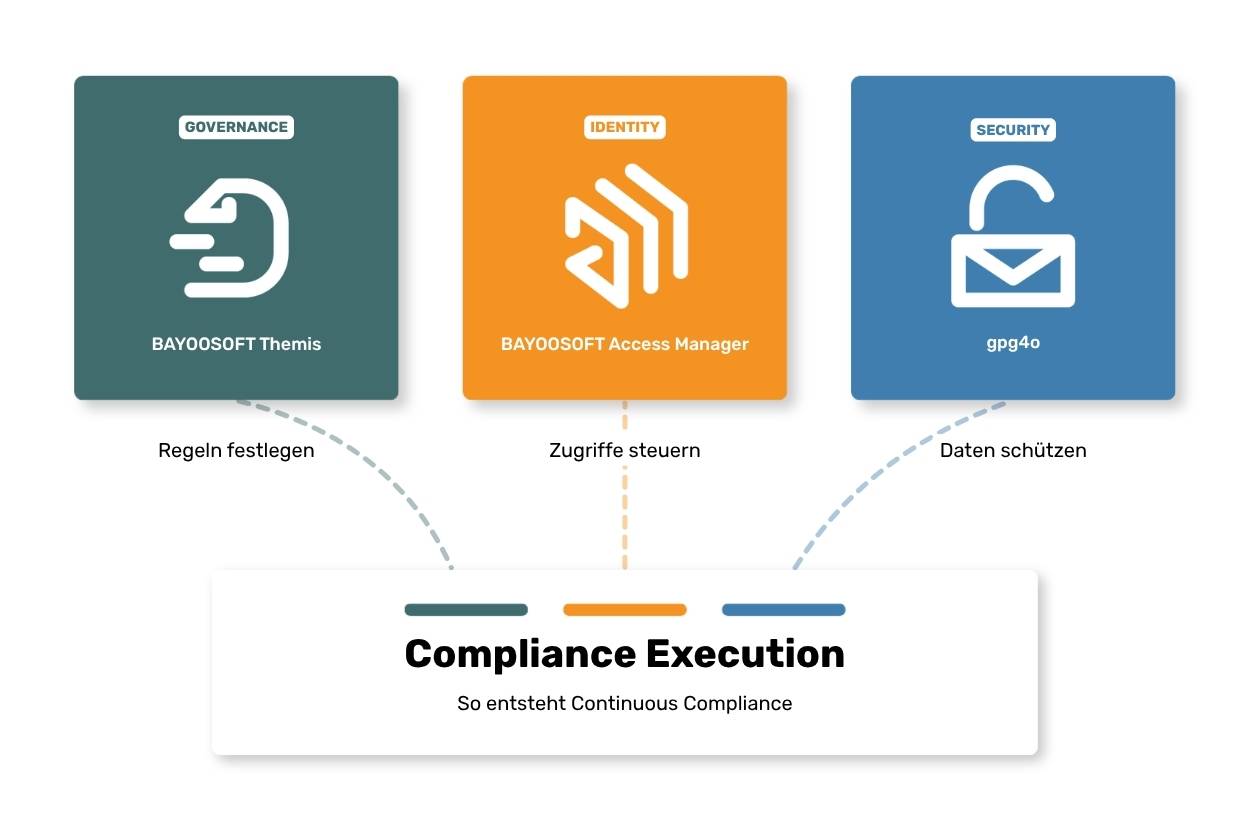
This gap between policy and reality cannot be bridged by a single department. It arises at the intersections of three worlds: Governance defines what should apply. Identity management controls who is allowed to access what. And security ensures that what needs to be protected remains protected. In many organizations, these three areas operate side by side, and it is precisely in the gaps between them that the gap widens.
Compliance Execution describes the approach to combining these three perspectives into a unified operating model. Requirements are linked to the underlying processes and supporting documentation, so that a guideline becomes a permanently effective and verifiable reality. Governance (BAYOOSOFT Themis) defines, Identity (BAYOOSOFT Access Manager) implements, and Security (gpg4o) protects. Compliance Execution brings these components together, turning documented compliance into a reality that holds up in everyday practice.
Conclusion
The most costly gap in your compliance isn’t the one in a document. It’s the one that arises between what you’ve written down and what actually happens in your system. It doesn’t cost you anything right away. You’ll pay for it later, when an audit comes up or something goes wrong and the supporting documents are missing.
Anyone who wants to close these gaps must stop merely documenting compliance and start putting it into practice: continuously monitoring, making targeted corrections, and providing ongoing evidence. Documented compliance is the prerequisite. Effective compliance is the goal.